Long read
Oceania: The Scattered Constellation of the Sea
≈ 7 min read · where the map dissolves into water
Spread a map of the Pacific across a table and you will mostly see blue. The land here arrives as an afterthought — flecks of green and white pressed into a hemisphere of ocean, thousands of kilometres apart, each one a world that took its own slow shape. To travel Oceania is to learn that distance is not emptiness. The water between the islands is the country; the islands are simply where you come up for air.
Lagoons you could fall into
There is a specific shade of turquoise that exists only over a tropical lagoon — shallow water above white sand, lit from below as much as above. In French Polynesia, the islands of Bora Bora and Mo’orea wear this colour like a halo, ringed by overwater bungalows that step out across the shallows on wooden stilts. From a hammock slung over the rail, you watch reef sharks cruise the channels beneath your feet.
It is shameless luxury, and it works. But the lagoon is older and stranger than the resorts perched on it. These are drowned volcanoes, their reefs grown over millions of years into living walls, and the water that looks like a swimming pool is in fact one of the busiest neighbourhoods on Earth.
The reef and the ray
Slip below the surface and Oceania reveals its real population. Coral gardens stack in terraces of orange, lavender and improbable electric blue; clouds of anthias scatter and reform; a green turtle chews seagrass with the patience of something that has all century. The great encounter, though, is the manta ray — a creature the size of a small plane that banks overhead in total silence, mouth agape, and makes you feel, briefly, like furniture in someone else’s living room.
Many peoples, one ocean
Oceania is not one culture but a vast braid of them. Polynesians sailed east into the rising sun and seeded islands from Tonga to the edges of the map; Melanesians built the dense, multilingual societies of Vanuatu and Papua New Guinea, where a single country can hold over eight hundred languages. A welcome in Fiji, a sand-drawing in Vanuatu, a sing-sing in the Highlands — each is its own grammar of belonging, and the traveller is a guest inside it, never the point of it.
The slow ceremony of kava
Sooner or later in Fiji, Tonga or Vanuatu, someone will hand you a coconut shell of kava — a muddy, earthy infusion of pounded pepper root that numbs the lips and softens the evening into something boneless and unhurried. You clap once, you say bula, you drink it down in a single go, you clap three times. Around the bowl the talk loosens and lengthens. Kava is not a drink so much as a way of agreeing, together, to let the day end slowly.
Fire under the green
Much of Oceania is freshly made. The islands of Indonesia and the Philippines string along the Pacific’s Ring of Fire, their volcanoes still smoking; in Vanuatu you can stand at the rim of Mount Yasur and feel the ground cough lava into the dark. Elsewhere the fire has gone quiet and the jungle has won — but the steepness, the black sand, the hot springs in the forest all whisper that this land is young, and still arguing with the sea.
When to go, and how to arrive
Aim for the dry season — roughly May to October across most of the South Pacific — when the trade winds are gentle and the cyclone risk fades. But the deeper advice is about pace. Distances are real and flights are infrequent; choose two or three islands rather than ten, and let the gaps stay empty. Learn the greeting, ask before you photograph, dress modestly off the beach, and surrender to island time, where the boat leaves when it leaves and the afternoon is for nothing in particular.
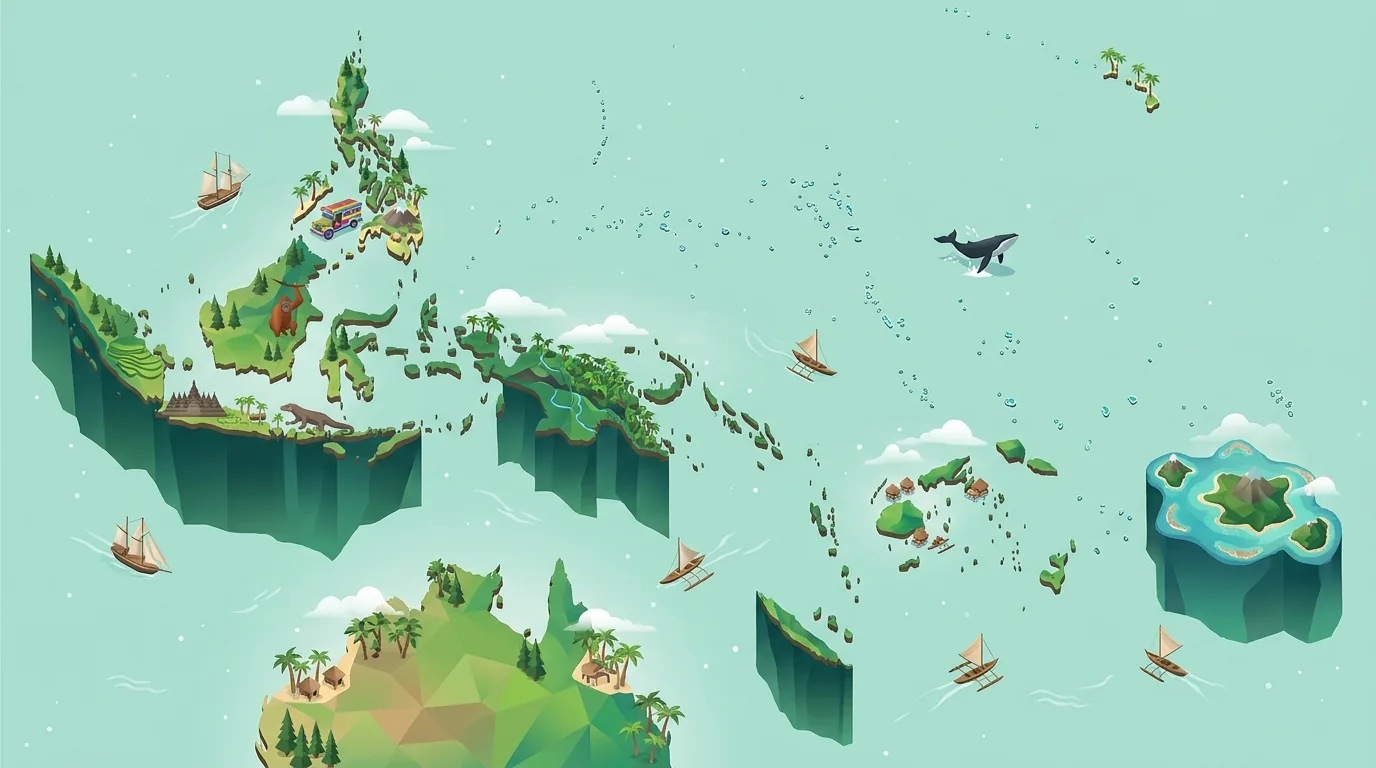
The map above is our pick of places worth the drive. Tap a cell to open details, or hit the list next to the title for every city and sight A–Z, searchable.