Long read
Where the Map Began: A Slow Crossing of the Middle East
≈ 7 min read · from Petra’s rose stone to Cappadocia’s dawn balloons
No region carries more weight in the imagination, or more misunderstanding. The Middle East is where writing was invented, where three faiths trace their roots, where the oldest continuously inhabited cities still wake to the call of street vendors. Travel here and the headlines fall away, replaced by mint tea poured from a great height, by the smell of cardamom and grilled lamb, by strangers who insist you eat before you leave.
Petra, carved out of patience
You reach Petra the way the Nabataeans intended: on foot, through a kilometre of slot canyon called the Siq, walls leaning close overhead. Then the rock parts and the Treasury appears, its columns cut directly into a cliff the colour of dried roses. Arrive at first light and you may have it nearly to yourself.
But Petra is not a single facade. It is an entire city of tombs, staircases, and high places, and the climb to the Monastery rewards you with sandstone striped pink and ochre, and a Bedouin tea stall where the kettle is always on.
Wadi Rum and the weight of silence
An hour south, the desert of Wadi Rum opens into something cinematic and ancient. Red dunes pile against granite massifs; Bedouin camps glow at dusk; the night sky is so thick with stars it feels closer than the ground. Sleep in a camp here and you understand why T. E. Lawrence called it vast, echoing, and godlike.
Dubai, a city that bet on the future
Then there is Dubai, where towers erupt from flat desert as if conjured. It is easy to be cynical about the spectacle, harder once you are inside the old Deira spice souk, haggling over saffron, or crossing the creek in a wooden abra for a single dirham while skyscrapers shimmer behind you. The new and the old share one tide.
Persia, in tilework and poetry
Iran rewards the patient traveller more than almost anywhere. In Isfahan, the great square is rimmed with mosques whose domes dissolve into blue and gold tilework; in Tehran and Shiraz, the bazaars are labyrinths of carpets, copper, and dried limes. Iranians practise hospitality as something close to art, and the ritual of being invited for tea by a near-stranger is not the exception here but the rule.
Istanbul and the seam of two worlds
Istanbul does what no other city quite manages: it stands with one foot in Europe and one in Asia, ferries stitching the two halves across the Bosphorus. Wander from the Grand Bazaar to a backstreet tea garden and you move through Byzantine domes, Ottoman mosques, and a modern city that argues, laughs, and feeds you mezze until you surrender.
When to go, and how to go gently
Spring (March to May) and autumn (September to November) are kindest across most of the region, sparing you the brutal summer heat of the Gulf and the deserts. Dress modestly at religious sites, learn a few words of Arabic, Persian, or Turkish, and accept the tea when it is offered. Hospitality here is not transactional; refusing it too quickly can read as a small rejection. Go slowly, ask questions, and let plans bend around the people you meet.
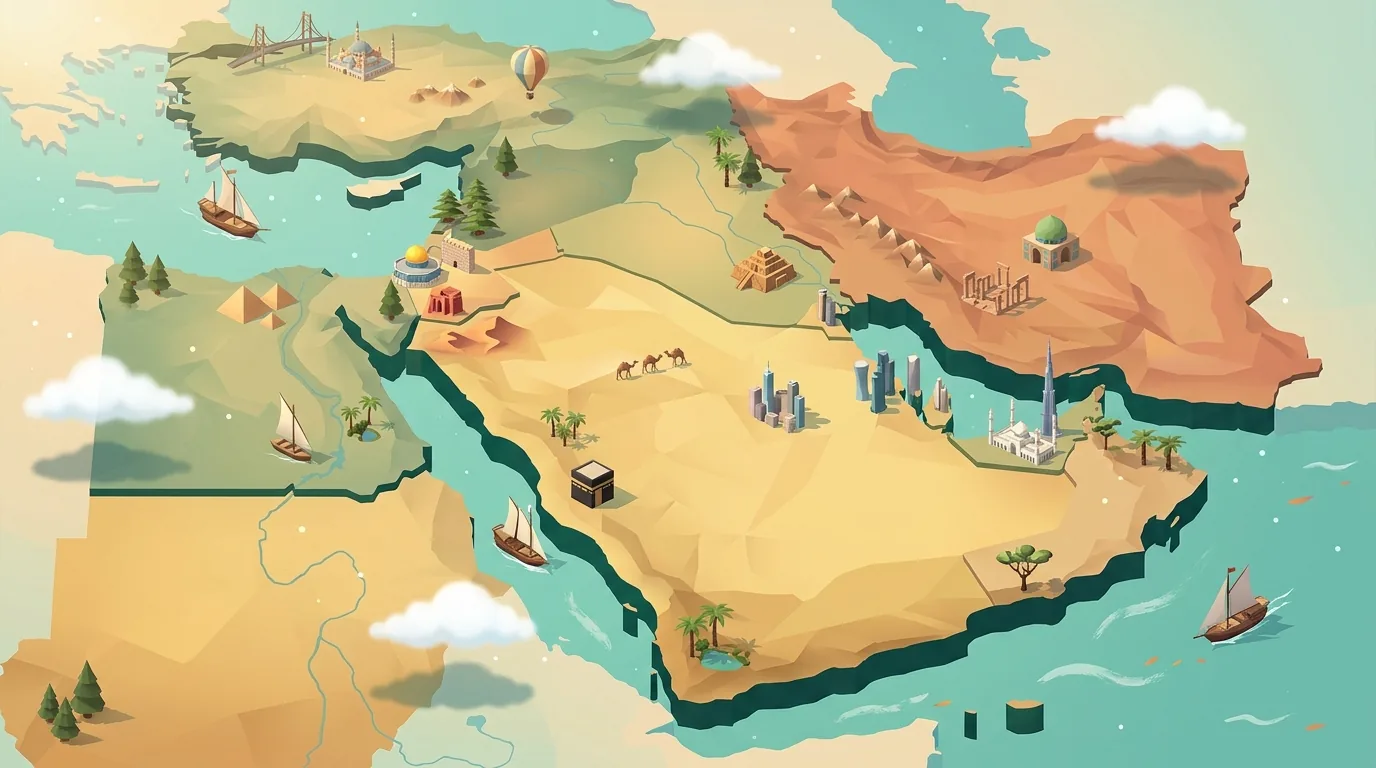
The map above is our pick of places worth the drive. Tap a cell to open details, or hit the list next to the title for every city and sight A–Z, searchable.