Long read
The continent that holds a thousand years and tomorrow in the same breath
≈ 7 min read · Asia past the postcard
You can land in Asia a dozen times and never arrive in the same place twice. One flight drops you into a valley where a monk is sweeping a courtyard that has been swept the same way for six centuries; the next drops you onto a platform in Tokyo where a train slides in so quietly you feel it before you hear it. Nobody warns you that the jet lag is the easy part. The hard part is the whiplash — the way a continent this size refuses to settle into a single story, and dares you to keep up.
Stone that grew like a forest
Start with the rock. Across Halong Bay in Vietnam and the Guilin river country in southern China, the limestone does not sit in ranges — it stands in thousands of separate towers, each one a green-furred island pushing straight up out of flat water or flatter rice. Drift between them in a wooden boat at dawn and the scale plays tricks: a fisherman two hundred metres off looks like a pencil mark on grey silk.
These are the bones of an ancient seabed, dissolved by rain over millions of years into a stone forest you can paddle through. In Guilin the fishermen still work at night with trained cormorants and a single lamp; in Halong the same shapes turn ghostly in the afternoon haze, and you understand why every classical Chinese scroll painter spent a lifetime trying to get this exact light onto paper.
Cities that run on electricity and instinct
Then the opposite extreme. Tokyo, Bangkok, Shanghai — megacities that treat midnight like an early afternoon. In Bangkok the heat finally breaks after sunset and the city pours into the street: scooters threading between food carts, the smell of grilling pork and lemongrass, neon stacked ten storeys high in a script you cannot read. Shanghai answers with a skyline that looks rendered rather than built, and Tokyo with a quiet so engineered it feels like a different planet from the Shibuya crossing two stops away.
Up where the air thins out
Go high enough and the noise simply stops. In Nepal the trail to a mountain monastery climbs past the last tree, past the last village, until the only sound is wind dragging across faded prayer flags and the distant crack of ice on an eight-thousander. Monks have lived up here for a thousand years not in spite of the thin air but because of it — because at this altitude the Himalaya strips everything down to stone, breath, and a horizon serrated with white peaks that genuinely defeat the camera.
The temples that move with the seasons
Down in the valleys, the spiritual register changes again. Kyoto keeps more than a thousand temples, and for two weeks each spring the cherry blossom turns the whole city into something the Japanese have a single word for — the ache of a beautiful thing you know is about to end. Further south, the stone faces of Cambodia’s Angkor rise out of the jungle at dawn, root and sandstone now inseparable, a city that the forest tried to swallow and only half succeeded.
Eaten best at a plastic stool
And then there is the food, which in Asia is rarely an event and almost always the texture of ordinary life. The real meals happen at night markets in Chiang Mai and Hanoi and Taipei — a single vendor who has cooked one dish for thirty years, a wobbling plastic stool, a bowl of broth that ruins every restaurant version you will ever order again. You point, you sit, you eat, you are handed something you cannot name and it is the best thing you taste all month.
When to go
Asia is too big for one season. Aim for the shoulder months: March to April and October to November dodge both the monsoon and the worst of the heat across most of Southeast Asia, while the Himalaya is clearest in autumn. For Japan’s cherry blossom you are at the mercy of a two-week window that shifts every year, so book loose and chase the forecast north as it opens.
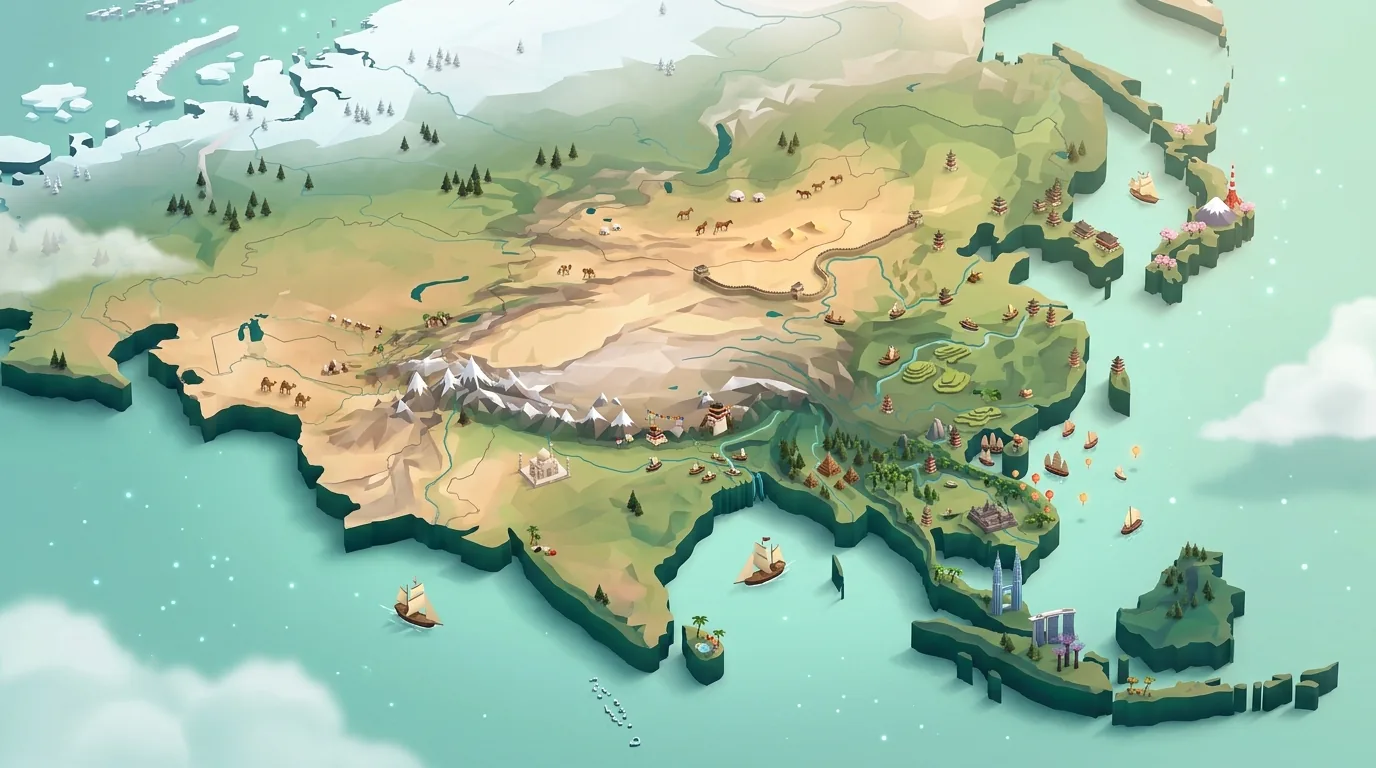
The map above is our pick of places worth the drive. Tap a cell to open details, or hit the list next to the title for every city and sight A–Z, searchable.