Long read
Africa: The Continent That Will Not Whisper
≈ 7 min read · from Sahara dust to Serengeti thunder
Africa does not ease you in. You step off the plane in Nairobi or Marrakech and the air already has a temperature, a smell, an opinion. This is not a place you observe from behind glass; it leans in close and refuses to be background. From the dune fields of Namibia to the spice fog of a Moroccan souk, the continent runs on a scale that makes you recalculate what a horizon is for.
The migration, and the sound it makes
There is a moment on the Serengeti–Masai Mara plains, usually around July, when roughly two million wildebeest and zebra decide to cross the Mara River at the same time. You hear them before the light is good enough to see: a low, continuous drumming through the ground, then dust, then the animals themselves, pouring over the bank in a panic that is also a kind of order. This is the Great Migration, and no documentary prepares you for the smell of it or the way the river goes briefly silent before the first one jumps.
A safari dawn is a ritual. You wake in the cold dark, drink bitter coffee from a tin cup, and drive out as the sky turns the colour of a bruise healing. Lions are still working. The plains stretch flat to a curved edge, and the silence between engine-off moments is so total it feels like a pressure on the ears.
Egypt: arithmetic in stone
The pyramids are not in the empty desert of the postcards. They sit at the literal edge of Cairo, a city of traffic and minarets pressing right up to the plateau. Walk to the base of the Great Pyramid and the abstraction collapses into limestone blocks taller than you are, stacked into the sky by people who had no iron and no wheel for the heavy work. Stand there at closing time, when the tour buses thin out, and the pyramids of Giza stop being a symbol and start being a weight.
Morocco: the medina and the long sand
Marrakech is an argument you happily lose. The medina is a knot of alleys where you smell cumin, leather, mint and woodsmoke within ten paces, where a man hammers brass while a cat sleeps on a sack of dates. Then you drive south, over the High Atlas, and the noise simply stops: the Sahara opens up, the dunes of Erg Chebbi go apricot at sunset, and the only sound is sand moving against sand.
Why the scale undoes you
People say Africa is big, but the word does the wrong work. It is not big like a country; it is big like an idea you cannot finish having. You can fly for three hours over Namibia and see nothing built by a human. You can stand on the Serengeti and watch a thunderstorm happen forty kilometres away while you stay dry in the sun. The continent gives you distance back as a physical sensation, and most travellers do not realise how much they had missed it until it returns.
South Africa and the waterfalls of the south
Cape Town is the continent showing off. Table Mountain drops a flat-topped wall straight into the sea, the cloud pours over its lip like a slow waterfall locals call the tablecloth, and the city stacks its colour up the slopes below. Push north toward the Zambezi and you reach Victoria Falls, where the river throws itself off a basalt cliff in a curtain a kilometre wide; the spray rises so high the locals named it Mosi-oa-Tunya, the smoke that thunders, and you feel the ground tremble before you are even wet.
When to go, and how to not get it wrong
For the river crossings of the migration, aim for July to September in Kenya and Tanzania; for the dunes of the Namib and the Cape, the dry winter months from May to September give clear cold mornings and gentle light. Egypt and Morocco are kindest in spring and autumn, when the desert sun negotiates rather than dictates. Whatever the season, build in slack: African distances are honest, roads are not, and the best moments — a leopard in a fever tree, a Saharan night with too many stars — never arrive on schedule.
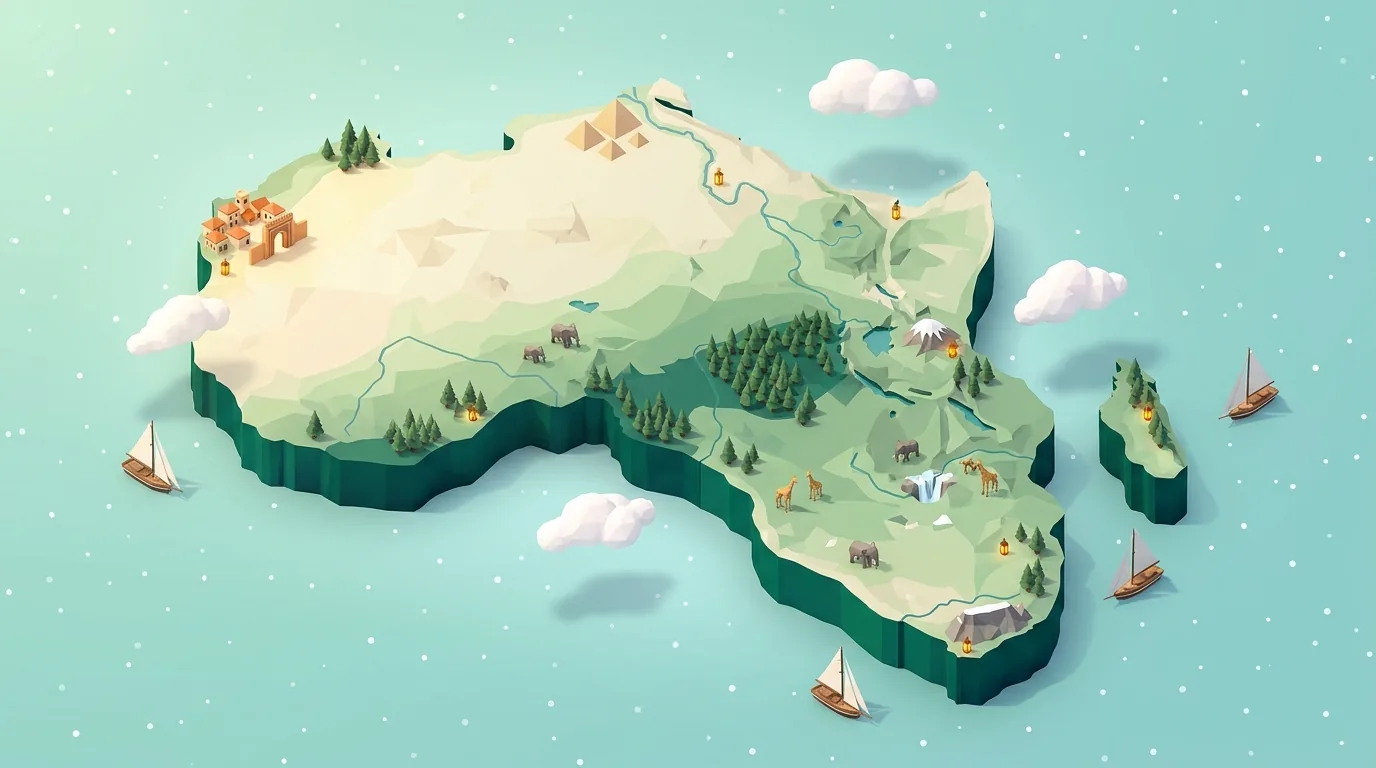
The map above is our pick of places worth the drive. Tap a cell to open details, or hit the list next to the title for every city and sight A–Z, searchable.